
Searching Georgia Court Dockets
Read the court name on whatever paper opened the case. Georgia sorts its trial courts into six classes, and each class keeps its own docket. Even offices that share staff may split their records. Begin at Georgia Courts E-Access, the official directory. It routes you to a chosen court's provider, and some providers require an account. A second route exists through re:SearchGA, a participating-courts search. Its coverage is incomplete, though, and public materials never fully describe it.
Follow this order when you track a filing, a setting, or a case's status:
- Read the citation, summons, indictment, or order and note the Georgia county and court class.
- Open Georgia Courts E-Access and choose that Georgia county and court; expect a provider sign-in after the redirect.
- Search with the full Georgia case number when available. If not, use the party or case-style controls that the local portal offers.
- Read the newest Georgia docket entries and open the signed order or filing when it is available. An event label alone may not show what the court decided.
- For a missing document or a certified copy, ask the Georgia clerk who keeps that court's file. Use the County Directory to find the local route.
The statewide path in Georgia is a doorway into local systems. One search result will not hold the whole record. A blank result could mean the wrong court, a portal gap, an access limit, or a filing that has not shown up online yet.
If a Georgia Case Is Missing Online
A case missing from one Georgia portal may still sit in the court's file. Check the document first for the class: Superior, State, Probate, Magistrate, Juvenile, or Municipal Court. Confirm the Georgia county, then try the court's current E-Access link. Georgia's official directory links a Superior Court portal for every county. It also links many State Courts. It offers no shared statewide query, and lower-court access may be separate.
For participating courts, re:SearchGA adds a second search path. No public material gives a full county or case-class roster. Nor does it publish a refresh interval or a history cutoff. Sealed juvenile matters and filings behind an account gate may never reach public results.
If the second search fails, write down the court and case number from the notice. Then call the Georgia clerk who maintains that court's record. The clerk can tell you whether the system runs behind. The clerk can also say whether the record predates the online range, or whether a rule restricts access. Georgia's county directory helps you find the right courthouse layer.
Note: A missing index entry in Georgia does not prove the docket or court paper is absent from the county file.
Inside the Georgia Statewide Case Search
No single public trial-court database covers every Georgia case. Instead, the Georgia Courts E-Access to Court Records page works as a directory of county and court links. It is a live one. Treat it as a router rather than a search form. Pick a county and court. Follow the provider link, and accept that destination's account or document conditions. Every county's Superior Court appears; State Court links exist for many counties. Other court types may run separate systems or offer no linked portal there.
Tyler re:SearchGA searches records from participating Georgia courts. A 2021 public guide describes its modes and filters. It never establishes today's full participation list or date range. Read the labels below as documented features, not a promise that every account shows every option.
| Search control | Documented use | Limit |
|---|---|---|
| Cases | Search Georgia case records | Only participating courts; not a complete index of Georgia cases |
| Filings | Find Georgia filing records | Exact current filters depend on the live service |
| Text in Documents | Search Georgia document text where available | Access follows source-document restrictions |
| Hearings | Search Georgia hearing information | Participation and current options are not fully published |
| Keyword | General Georgia search field in the 2021 guide | Current field wording and matching rules may change |
| Location | Filter records by Georgia location | Full current option list was not publicly inspectable |
| Case Category / Type / Status | Named Georgia filters in the guide | Available values depend on the live account |
The index helps you find a participating record. It cannot replace the county clerk's official docket, the filed papers, or a certified copy. For how the system roles and county-to-state flow work, see the Georgia Court System page.
Georgia E-Access Routes by County and Court
The official Georgia Courts E-Access directory lists county and court choices that lead to different providers. That routing page is what appears here, not a statewide docket result. Each provider may demand an account and set its own search and document rules.
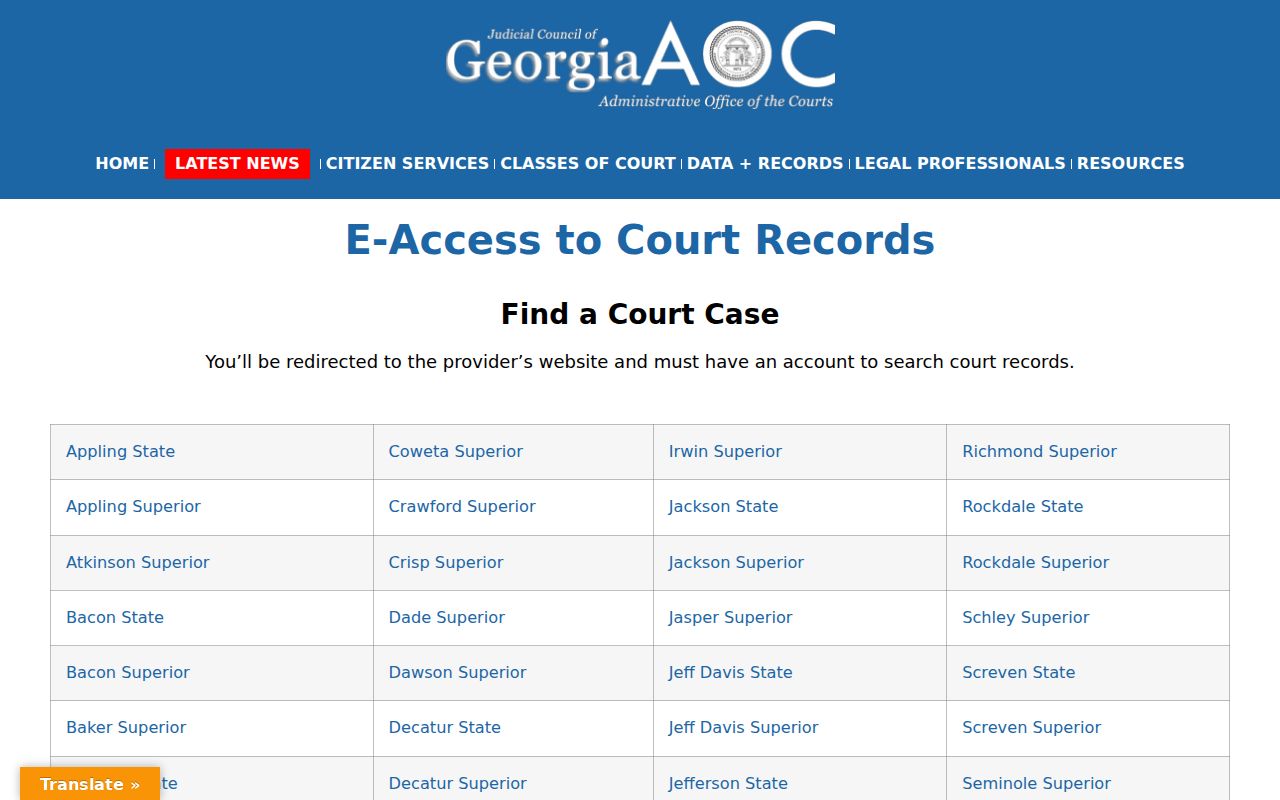
Every Georgia search needs both county and court. A neighboring court may use another vendor or offer no linked online search at all.
Which Georgia Courts Keep Dockets
Georgia's trial courts come in six distinct classes. Superior Court serves as the general-jurisdiction trial court. It covers felony cases, divorce, title-to-land disputes, equity, and major civil matters. State Court takes county misdemeanors, traffic, and civil matters outside Superior Court's exclusive jurisdiction. Probate, Magistrate, Juvenile, and Municipal Courts each carry their own statutory or local work. Two appellate courts sit above them and open a separate record after an appeal. The judiciary's court guide spells out each court's role.
| Court | Docket Covers | Where to Search |
|---|---|---|
| Georgia Superior Court | Felonies, divorce, land title, equity, broad civil claims | County Superior portal or Clerk of Superior Court |
| Georgia State Court | Misdemeanors, many traffic cases, county civil matters | State Court link or its local clerk |
| Georgia Probate Court | Estates, wills, guardianships, and some assigned traffic matters | Probate Court Clerk or county portal |
| Georgia Magistrate Court | Civil claims up to $15,000, dispossessory cases, warrants | Magistrate Court Clerk or local system |
| Georgia Juvenile Court | Juvenile Code matters and traffic cases for children under 17 | Juvenile clerk; access is restricted by law |
| Georgia Municipal Court | City traffic, ordinance cases, warrants, and preliminary matters | City court clerk or linked municipal portal |
| Georgia Court of Appeals / Supreme Court | Appeals, applications, briefs, orders, opinions | Each appellate court's own system and clerk |
Georgia has no general county-court tier, and cases do not climb the trial classes like a ladder. Jurisdiction turns on the matter and the court named on the filing. Note that a shared clerk's office can still route each court class to its own record and portal.
E-Filing in Georgia Uses a Court Matrix
Georgia attorneys file through whichever vendor a particular court and county use. Three services dominate: Odyssey eFileGA, PeachCourt, and GreenFiling/InfoTrack. The AOC matrix lists them court by court. It flags each one as mandatory, available, or not listed. Don't confuse that matrix with the public E-Access directory. They answer different questions. Also keep in mind that e-filing a document does not put its image straight into a public docket. For the vendor a given court uses, the AOC e-filing matrix is the place to look.
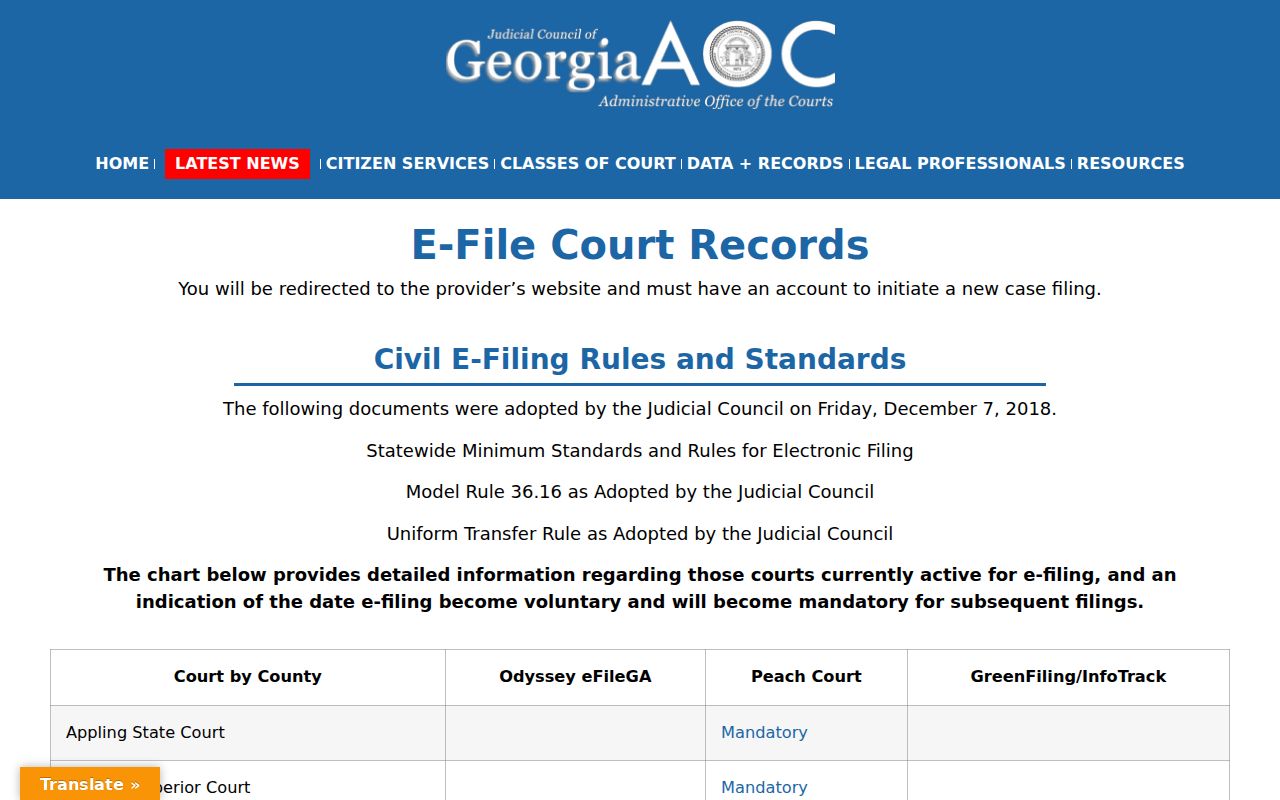
Once a filing lands, the court or clerk processes it inside a case-management system. A public portal then shows whatever the court permits. A submitted motion may sit unaccepted, and an accepted filing still isn't a ruling. Georgia sets no statewide refresh timetable. Is an event missing from a docket? Ask the clerk whether it is still processing or lives in another court portal.
What a Georgia Court Docket Shows
A docket is the court's event index. It is not a transcript of everything that happened. Vendor screens differ across Georgia, and some case-level fields stay behind a login. A portal might show the case header and filing descriptions while tucking the linked order or pleading into a separate viewer. When a result label doesn't answer what the court did, open the actual document.
| Georgia Case Number | The court's identifier; preserve the full number and any year or court prefix displayed by the local system. |
|---|---|
| Parties / Style in Georgia Cases | The caption gives the short case title. Restricted or juvenile matters may hide identifying details. |
| Georgia Docket Entries | A chronological list of filed papers and court events; vendor labels are not uniform statewide. |
| Hearing Settings in Georgia | A date, time, or event may appear in a hearing tab or notice. Check the newest order. |
| Georgia Court and Clerk | Shows which court record is being viewed and helps identify the record custodian. |
| Georgia Disposition | A status or outcome label. The judgment or signed order gives the controlling terms. |
On a Georgia civil docket, a motion entry is a request. Granting it is a separate step. On the criminal side, "dead docket," "nolle prosequi," dismissal, and bind-over are not interchangeable outcomes. Read the signed order. If the case moved or was appealed, search the new court too.
Georgia Docket Terms Depend on Court
No single event vocabulary spans every Georgia vendor. An AOC statistical category exists for statewide reporting. A county portal may instead show the local filing title or the judge's own order description. These terms can orient a search, but the document and court record control.
- Calendar call (CC)
- A Georgia scheduling session to check readiness or set later dates. It is not automatically the trial.
- Continuance
- A court-approved postponement in Georgia. Look for a later setting or order.
- Dead docket
- A Georgia criminal status category that is not the same as a dismissal or acquittal.
- Disposition
- The recorded outcome or status when a Georgia case is resolved or closed; read the signed order for details.
- Motion
- A request for a Georgia court order. Filing a motion does not mean a judge has ruled on it.
- Reset
- A new Georgia date or calendar placement. Confirm which earlier setting it replaces.
Short calendar labels like ARR, CIV, CRI, GJ, DC, and MHC show up in the Mountain Judicial Circuit's local schedules. They come from one circuit, so treat them as examples rather than statewide codes. A Georgia docket entry can point to a calendar or order that fills in the context.
Georgia Public Access to Dockets
Many Georgia court records are open. The authority comes from court statutes, rules, and clerk procedures. It does not flow from a single general law. The Georgia Open Records Act, O.C.G.A. §§50-18-70 et seq., covers public agencies within the Act. Attorney General guidance says Superior, State, Probate, and Magistrate Courts sit outside that general process. So send a court file request to the clerk, not an executive-agency records form.
Superior Court Rule 21 starts from public inspection. It provides a court procedure for restricting access. Juvenile records carry separate statutory limits. Redacting a personal identifier is not the same as sealing the whole case. When a portal leaves something out, the reason could be a rule, an order, a provider gap, or a login condition. The clerk can say which.
Georgia access rules:
Uniform Superior Court Rule 21 provides for public inspection unless law or a court order limits access; Rule 21.6 addresses covered redactions.
Georgia Open Records Act, O.C.G.A. §§50-18-70 et seq. governs covered agencies; it is not the court-file request route identified by the Attorney General for several trial courts.
O.C.G.A. §§15-11-700 and 15-11-704 restrict public access to juvenile hearings and case files, subject to statutory exceptions.
Start with the right court. Ask its clerk for access, copies, or the basis for any restriction. The Georgia county directory routes you to that local office.
Georgia Court Counts Measure Different Work
That tally above mixes counts that measure different things. It is not one grand total of unique Georgia cases. The 159 counties and 51 Superior judicial circuits describe court geography, while the 227 judgeships count Superior Court bench positions under the 2025 workload assessment. The 714,037 figure counts State Court filings for calendar year 2024 alone.
So none of these numbers means the same thing. The AOC data and statistics pages define each measure and publish the guides behind them.
That Georgia State Court total breaks down further. It counts 454,964 other traffic cases, 28,616 DUI or serious traffic matters, 88,900 misdemeanors, 102,679 civil cases, and 24,666 probation revocations. Traffic clearly dominates reported Georgia State Court activity. Yet these categories do not count every ticket statewide. Georgia Superior Court filings use different case groups. Compare each Georgia figure with its court class and reporting year. These totals measure different workloads.
Georgia's ten Judicial Administrative Districts, 51 Superior circuits, and 159 counties are three different maps. A circuit can span several counties. Even so, case portals still route by county and court.
From Georgia's AOC to GA CMS
The Judicial Council of Georgia and the Administrative Office of the Courts handle policy, administration, education, technology, and statewide statistics. The AOC began in 1973 as a service organization for the courts. It does not hold every Georgia county's case file. Digital access in Georgia has grown in layers. E-filing standards arrived in 2018. Tyler announced an initial 15-county re:SearchGA launch in 2019. The public Georgia Judicial Council/AOC office is a statewide administrative resource. It is not a case clerk.
Georgia's Administrative Office of the Courts kicked off the Georgia Case Management System in January 2025. Its partners were AWS and Slalom. The FY2025 annual report lays out the plan, which starts with Superior and State Courts. Think of it as plumbing, though. It is not a public search destination for a Georgia court docket. A case lookup today still runs through E-Access or the county provider it points to.
Access stays local while the shared technology is built. The AOC matrix tells you current e-filing status. The judiciary directory covers public case access. Neither has been replaced by the GA CMS project yet.
Federal Court Dockets Use PACER
Federal cases never show up in a Georgia county portal. The state sits across three U.S. District Courts: Northern, Middle, and Southern. Each keeps its own venue and clerk. Bankruptcy runs through separate bankruptcy courts. Every federal docket report comes from PACER. It is a national system rather than a Georgia state-court search.
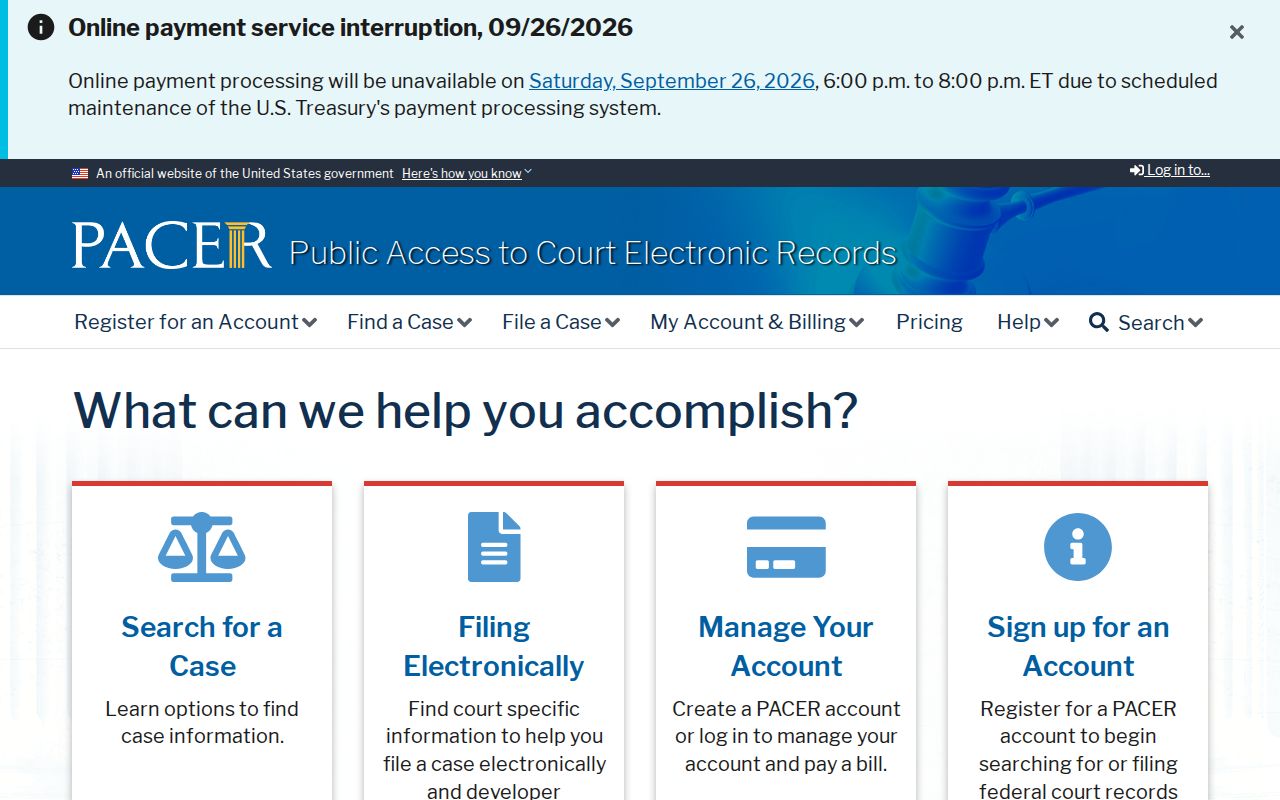
To find a federal case, open PACER's official access page and pick the right court. Registration is required, and federal page fees may apply.
There is a free angle for Georgia federal filings. CourtListener/RECAP lets the public search federal material that PACER users have shared. The archive is incomplete, though, and a recent filing may be missing. Treat it as a supplement. It is never a stand-in for the official federal docket.

A Georgia state appeal lives in two places. Check the originating trial docket and the separate appellate docket. Federal cases go through PACER or the federal clerk. The systems never share records.
Georgia Appeals Keep Separate Dockets
A notice of appeal may be noted in the trial case. But the real appellate work happens elsewhere. The Court of Appeals of Georgia or Supreme Court of Georgia opens a new record. It has its own case number. That second Georgia docket follows briefs, applications, oral-argument settings, orders, opinions, and later motions. Anyone tracking an appeal should hold onto both numbers and check both clerks.
The Supreme Court of Georgia's public interface offers a case-number search. Its online window runs five years. The Court of Appeals runs eFAST for counsel filing and case communication. Parts of it are not public search, though. Published opinions explain the court's reasoning. They are not a full event history.
Appeals also loop back. A remand or remittitur can restart activity in the original trial case. A transfer, consolidation, or de novo review can create linked numbers. Where the appellate system allows it, search the lower-court number there. Then return to the trial clerk for the transmitted record or transcript.
Court Dockets by County in Georgia
The statewide directory is only step one. A Georgia docket sheet lives with the clerk of the court that opened the case. One county may run several court classes with separate portals. Begin with the county printed on the citation, summons, or order. Then match the court. The counties featured here rank among the most populous in the 2025 Georgia Department of Community Affairs estimates. Population says nothing about case volume.
Fulton County
Atlanta · Georgia's largest county by the cited population estimate, with separate Superior and State Court search routes.
Gwinnett County
Lawrenceville · One of Georgia's largest metro court systems; select the court named on the case paper.
Cobb County
Marietta · Metro Atlanta courts include distinct Superior and State Court records.
DeKalb County
Decatur · A large metro county where court class matters when selecting an E-Access route.
Chatham County
Savannah · Coastal court system with separate Superior and State Court paths.
Cherokee County
Canton · A growing metro-area court system; check the current court-level portal.
Open the full County Directory of all 159 Georgia counties to reach any county's court docket site.
Note: Georgia county links lead to local sites, so pick the court named on the case paper to reach the right docket.