
Inside the Georgia Court System
Six trial-court classes make up the Georgia court system. They are Superior, State, Juvenile, Probate, Magistrate, and Municipal. Two appellate courts sit above them. These are the Court of Appeals of Georgia and the Supreme Court of Georgia. They do not stack into one simple appeal ladder. Which court reviews a case turns on three things: the court class, the case type, and the governing law. The Georgia Courts jurisdiction overview maps how the roles divide.
Superior Court is the general-jurisdiction trial court. It hears felonies, divorce, land-title disputes, equity matters, and larger civil claims. Every county has one. Each county also has a Clerk of Superior Court. A different local clerk may hold the records of a lower court. Once review begins, an appellate clerk opens a separate file, so a Georgia trial docket and its appeal docket stay distinct. The Supreme Court of Georgia's official docket search shows that split in practice. Appellate cases live on their own search route.
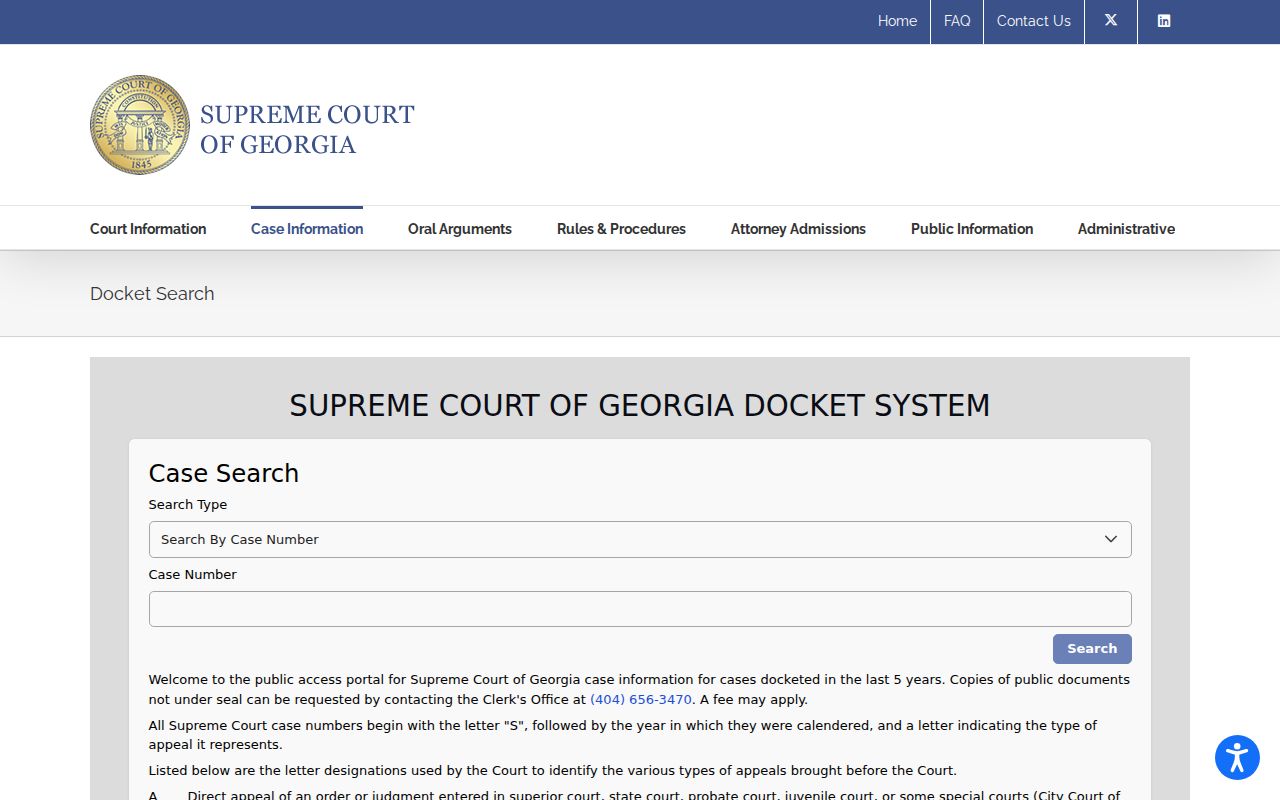
This interface covers Georgia appellate matters only. It is not a trial-case index. View the public appellate docket application to reach that separate search.
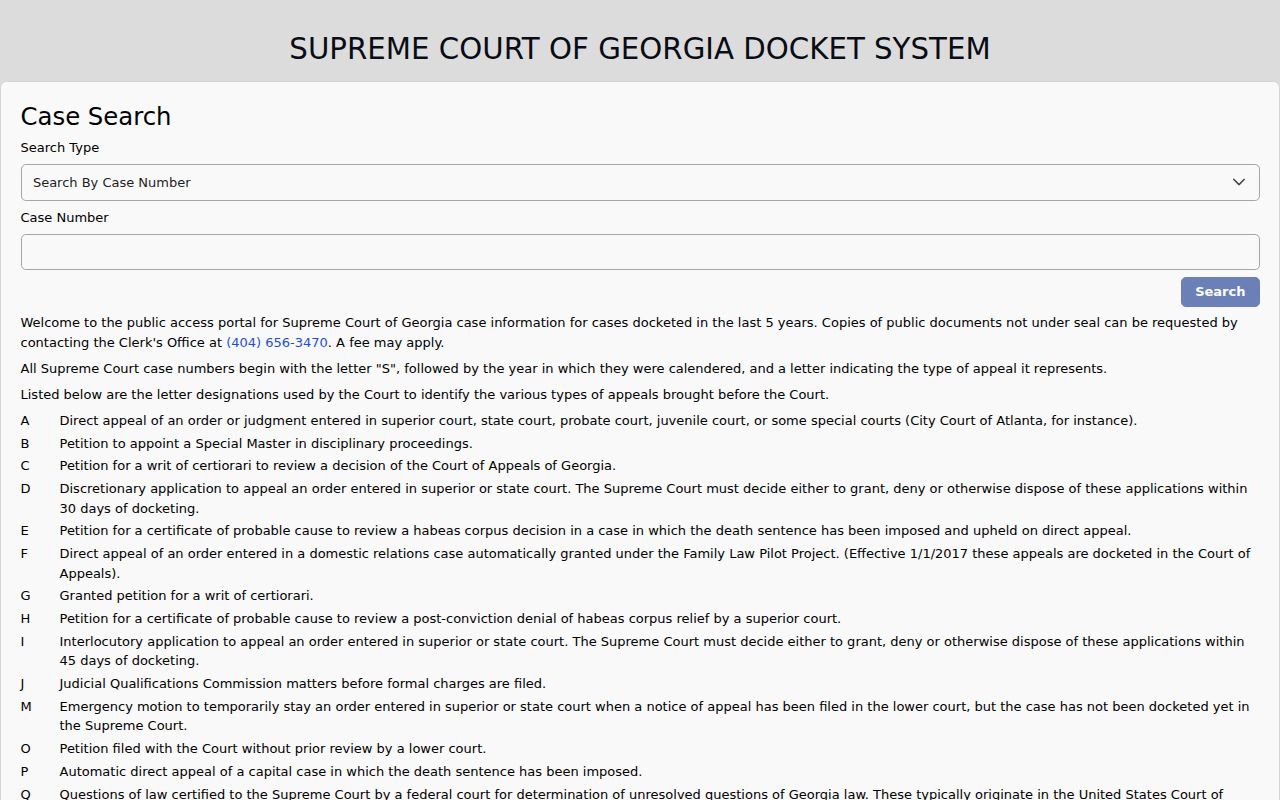
The Supreme Court interface lists Georgia high-court cases. The Court of Appeals of Georgia keeps its own case-information and opinion routes.
Six Georgia Trial-Court Classes Keep Different Dockets
Each of Georgia's six trial-court classes hears different cases. Each keeps records with a different clerk. Superior Court is one class among them, not a general county-court tier above the rest. Read the citation, summons, or case notice first. The Georgia court named there tells you where the docket lives. Learn that before any search by party name.
| Court class | Common matters | Record route |
|---|---|---|
| Georgia Superior | Felonies, divorce, land title, equity, and broader civil matters | Clerk of Superior Court |
| Georgia State | Misdemeanors, many traffic matters, preliminary proceedings, and county civil cases outside exclusive Superior jurisdiction | State Court Clerk or combined local clerk |
| Georgia Juvenile | Delinquency, dependency, child-in-need-of-services, and traffic matters for children under 17 | Juvenile Court Clerk; files have special access limits |
| Georgia Probate | Wills, estates, guardianship, and other statutory matters; some local traffic or misdemeanor work | Probate Court Clerk |
| Georgia Magistrate | Civil claims of $15,000 or less, dispossessory cases, warrants, and preliminary hearings | Magistrate Court Clerk |
| Georgia Municipal | City traffic, local ordinances, warrants, and preliminary proceedings | Municipal Court Clerk |
| Georgia State-wide Business Court | Qualifying business disputes under its statutory and rule criteria | Business Court Clerk |
State, Probate, Magistrate, Juvenile, and Municipal Court are separate classes in Georgia. They are not lower rungs of a single ladder. Their clerks, calendars, and online systems differ, even where one local office handles the paperwork for several of them.
The Georgia Statewide Search Portal
No complete public trial-case search exists for Georgia. E-Access serves as the official county-and-court directory. It routes users to separate providers that may demand accounts. It lists a Superior Court path for every county. It also lists many State Court paths, yet it does not search all lower-court dockets. Tyler re:SearchGA adds participating courts to the picture. Georgia publishes no measure of its total coverage, its history cutoff, or how often records refresh.
A local Georgia portal may show only summaries and events. Another might offer document images or split court searches. Search by county and court class first. Then ask the clerk for the full docket sheet. The Georgia case lookup process walks through the search fields.
| Access route | What it provides | Coverage limit |
|---|---|---|
| Georgia Courts E-Access | Current links organized by county and court class | Directory only; destination provider and account conditions vary |
| re:SearchGA | Cases, filings, document text, and hearings for participating courts | Not every Georgia court or case type; public coverage and refresh details are incomplete |
| County or court portal | Local case detail, docket events, and sometimes document images | Provider, history, login, and charges depend on the court |
| Appellate court systems | Separate appeal numbers, filings, orders, and opinions | Not a trial-case index; counsel and public functions can differ |
Open Georgia Courts E-Access for the current court and county routes.
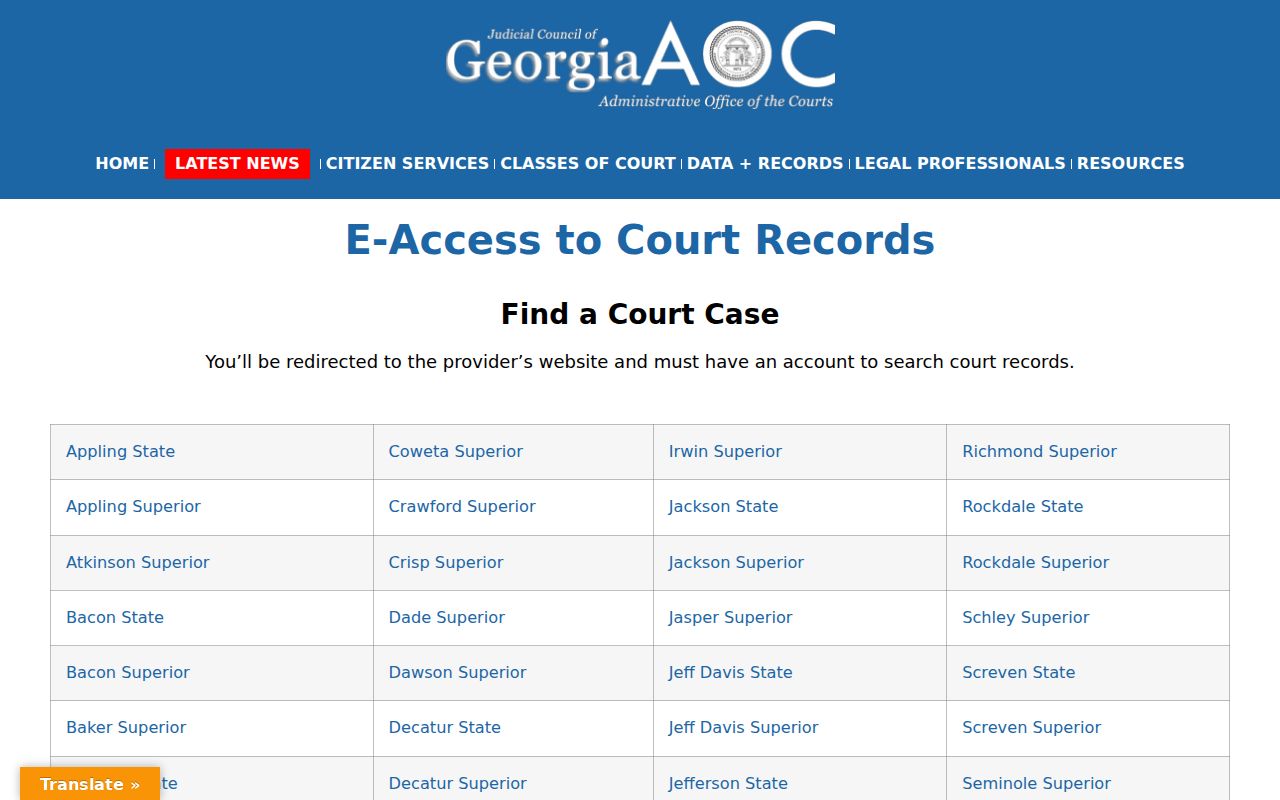
The directory routes you to providers; it never searches their dockets together. Open re:SearchGA for the participating-court search entry point.
For a participating Georgia court, try re:SearchGA. Confirm the result with that court's local clerk.
Note: E-Access is a directory, and re:SearchGA searches participating courts; their coverage and purpose differ.
Georgia Courts: Judicial Council and AOC
The Judicial Council of Georgia and its Administrative Office of the Courts (JC/AOC) coordinate policy, education, statistics, and technology. They do this statewide. The office publishes the E-Access directory, the e-filing matrix, annual reports, and data products. It keeps no trial court's original file. Nor does it run every local vendor portal. The clerk holding a Georgia case stays its records contact.
Judicial Council of Georgia / Administrative Office of the Courts
Statewide court administration and public judiciary resources
244 Washington Street SW, Suite 300, Atlanta, Georgia 30334
Phone: 404-656-5171
Georgia's Administrative Office of the Courts opened in May 1973. Act 178 created it. The Supreme Court reaffirmed the Judicial Council in 1978. JC/AOC links statewide standards and reporting with courts that remain locally administered. View the Judicial Council/AOC public office site for its programs and reports.
The statewide Georgia office supports court administration; each trial-court clerk keeps its case docket.
How Georgia Dockets Reach the State Index
A Georgia case begins in the court with authority over it. The local clerk opens the file in that court's case-management system. That clerk also keeps the official docket. Where e-filing is used, a vendor submits the attorney's filing. A public portal sits on top as a separate access layer. Some participating data reaches re:SearchGA. But no statewide feed carries every trial case into one index.
Record path: Georgia county or court filing › designated vendor, when used › local clerk and case-management system › court's public portal; participating data may also appear in re:SearchGA.
E-Access helps you find a Georgia provider. It is not a stage in any data pipeline. Court class, case type, access rules, and the vendor all shape a search. They shape what appears in it. When an event or image is missing, contact the clerk who holds the file. The Georgia County Directory routes you to that local court.
Georgia E-Filing Is a Matrix of Vendors
Georgia e-filing runs on several systems: PeachCourt, Odyssey eFileGA, GreenFiling/InfoTrack, and platforms built by courts or counties. Some of those platforms were built by courts. Others were built by counties. The JC/AOC matrix marks each Georgia court row as mandatory, available, or blank. A county's Superior Court vendor may differ from the vendor its other courts use.
Check the current Georgia row and your filing type first. Attorney e-filing and public case search are distinct tools. A vendor login never replaces E-Access. Registration, payment terms, and mandatory dates vary by court. View the official Georgia court-by-court e-filing matrix to find a current vendor and status.
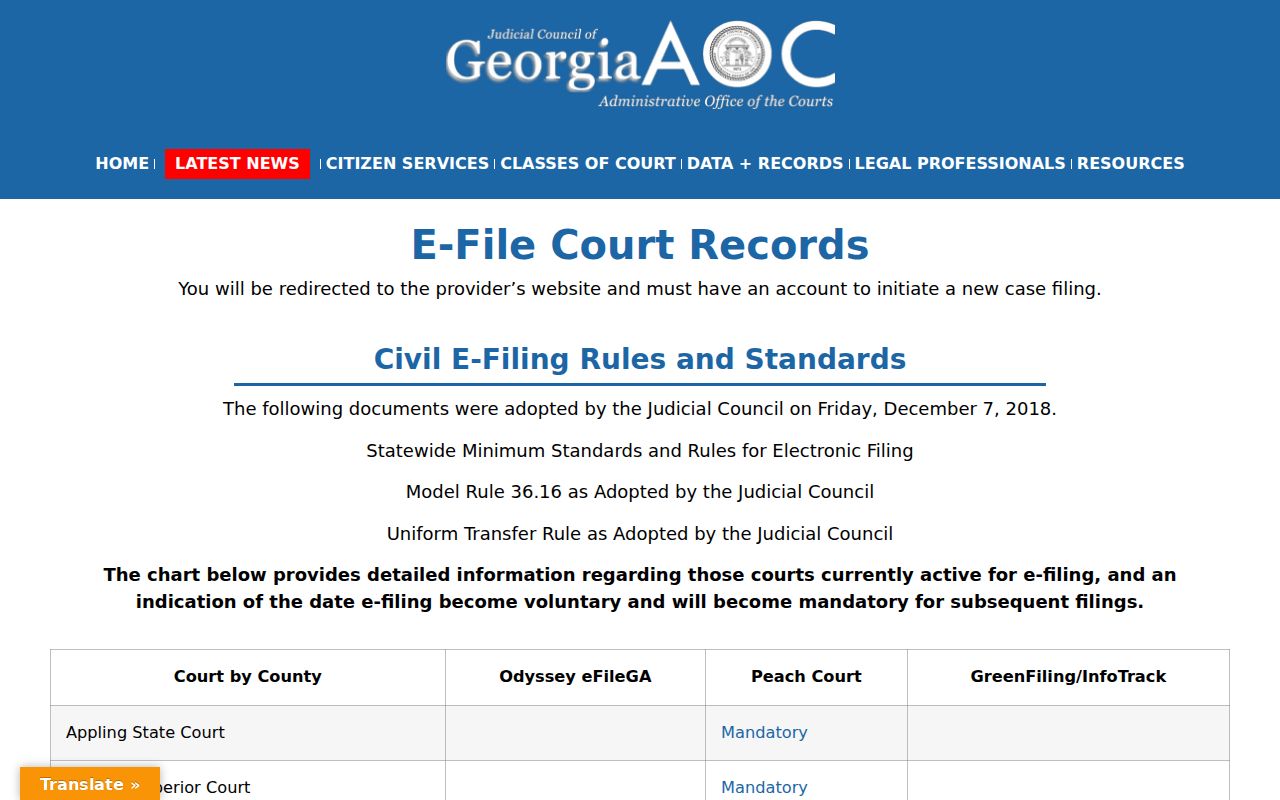
The matrix maps filing routes for Georgia courts. For public case research, follow the court's separate E-Access or clerk portal.
Note: A vendor used by some Georgia courts does not serve every court or provide one shared public case search.
E-Filing Through Georgia's Court Systems
Georgia attorneys e-file through the vendor their court and county use. PeachCourt, Odyssey eFileGA, and GreenFiling/InfoTrack are the big three, though some courts run a local system. The JC/AOC matrix shows each court's current status. On December 7, 2018, the Judicial Council adopted e-filing standards, Model Rule 36.16, and the Uniform Transfer Rule.
Georgia's filing labels need care. A document can await clerk review. An acceptance receipt proves only delivery. It is not a docket event and not a judge's order. Public search goes through E-Access or the listed court portal, even where the vendor also hosts filing access.
Georgia's 51 Circuits and 10 Districts
Georgia counts its courts three ways. A county is the local records route; a circuit groups counties for Superior Court; a district is an administrative layer above both. Get them mixed up and the docket search suffers, sending you to the wrong calendar or court.
- County
- The local level where each Superior Court and Clerk of Superior Court is located; lower courts also serve county or city areas.
- Judicial circuit
- A Superior Court trial-court grouping that includes one or several counties.
- Judicial Administrative District
- A statewide administrative division, not a second trial-court venue.
Current Georgia AOC materials put the state at 51 Superior Court circuits. They also list 10 Judicial Administrative Districts and 159 counties. Those numbers describe three different structures. A circuit name can help spot the right calendar. But county and court class identify the clerk with the record.
Georgia AOC data and statistics include maps and court-level reports.
For any Georgia portal, go with the court and county printed on the case notice. A circuit or administrative district alone may be too broad.
Georgia Portal vs County Docket
Georgia's statewide entry points help you find a case. The local docket holds its official history. E-Access routes you to providers, and re:SearchGA covers participating courts, but neither guarantees every filing or image. The clerk maintains the file and issues certified copies, so start with the Georgia County Directory to pin down the county and court named on the papers.
| Feature | Statewide Entry Point | County Court Docket |
|---|---|---|
| Role | E-Access routes to providers; re:SearchGA indexes participating courts | Local court system and clerk's official case record |
| Coverage | Provider links or participating-court results; gaps remain by court and case type | Records the named court holds, subject to law and orders |
| Docket detail | Can be a case summary or partial event history | Full docket sheet is maintained by the court's clerk |
| Documents | May link out, require an account, or omit images | Clerk can explain inspection and copy channels |
| Certified record | Not a substitute for clerk certification | Request from the clerk that has custody |
For a full Georgia docket or a copy, call or visit the clerk, use a public terminal, or follow its mail or email request process. Certified copies come only from the clerk.
Georgia's 2024 State Court Filings Need Context
The 2025 Georgia State Court Fact Sheet reports 714,037 State Court filings for 2024. That total spans criminal, traffic, and civil work. It measures one Georgia court class. It does not measure all cases statewide, nor unique pending matters. AOC categories and units differ across court classes.
Visit the AOC data and statistics portal for annual dashboards.
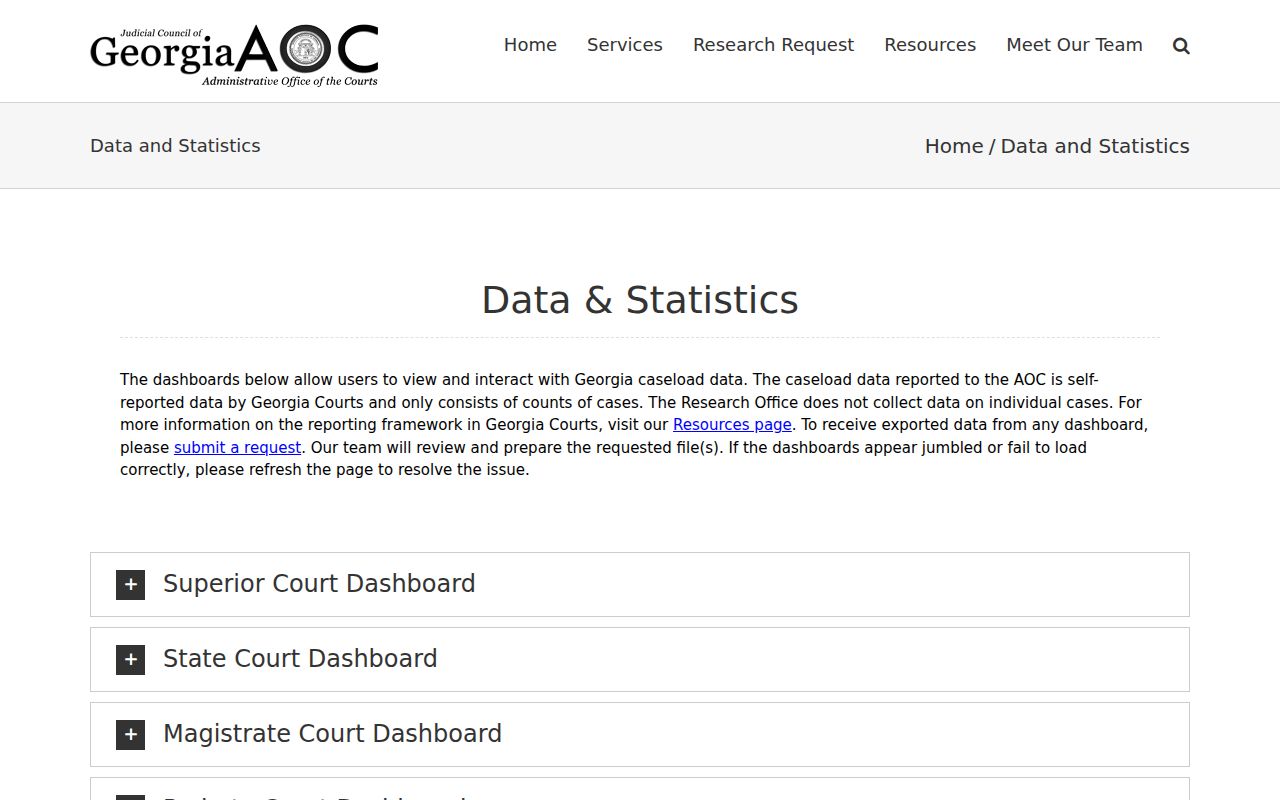
Georgia's dashboards show aggregate activity. They do not search cases. For one State Court docket, use its county and court in E-Access, or ask the clerk directly.
The 2025 State Court Fact Sheet defines what this CY2024 measure covers.
Note: Georgia's 2024 State Court filings count reported activity in one court class. They are not unique cases pending across all courts.
Georgia Court Technology and History
Georgia's court technology grew up in pieces. On December 7, 2018, the Judicial Council adopted e-filing standards, Model Rule 36.16, and the Uniform Transfer Rule. Tyler announced re:SearchGA on January 15, 2019, starting with a 15-county group. That launch group is not today's coverage. Check current Georgia court rows in the AOC matrix and E-Access.
The milestones paired statewide standards with clerks who run separate local case systems. A portal shows only what its court releases. Ask the local clerk about a missing file rather than assuming everything syncs across Georgia.
Tyler's re:SearchGA launch announcement of January 2019 tells the rollout story.
Georgia CMS: Future Court System, Not Search
The JC/AOC FY2025 Annual Report says the GA CMS project launched in January 2025. AWS and Slalom were picked after procurement. The build targets Georgia's fragmented systems, starting with Superior and State Courts. The report promises no finished public docket search. It offers no replacement for current Georgia portals.
Need a Georgia trial case today? Use E-Access and the local clerk. GA CMS is modernization work, not a search service for cases now. Check current court links and ask the clerk about a missing document.
The FY2025 Annual Report gives the project's stated scope.
Georgia's 2026 Recording Rule Changes Court Records
The Supreme Court of Georgia approved Rule 36.19 on January 29, 2026. Its effective date is February 26, 2026. The rule covers authorized Superior Court digital recordings. It also covers records-schedule retention. And it covers requested transcripts prepared by certified reporters. Georgia courts must set written local protocols.
The rule changes how a Georgia proceeding recording may be kept and transcribed. It creates no public audio-search portal. Not every recording becomes available. Ask the court about its transcript process and access rules.
The Supreme Court's Rule 36.19 order gives the official effective date. Its rules-amendment index gives the text.
Note: Rule 36.19 covers Superior Court recordings. It reaches neither every document nor every docket entry statewide.