
Getting Court Records in Georgia
Pull the court and county off any notice, order, or case number. Then work from there. Georgia Courts' E-Access to Court Records directory sends you to individual county and court providers. There is no single statewide trial-court search behind it. Expect to create an account at some destinations. For participating courts, re:SearchGA can help. Georgia does not document complete coverage of every court, county, case class, or filing, though. A summary online can also leave out the document image you wanted.
- Identify the Georgia court, county, case number, and document name from the notice or prior docket entry.
- Choose the Georgia county and court class in E-Access, then follow the provider's sign-in and search steps.
- Try Georgia re:SearchGA only if the court participates; search modes and filters vary by provider.
- If the item is not online, contact the Georgia court clerk by phone, email, mail, or at the counter. Ask whether a public terminal is available.
- State whether you need a Georgia docket printout, plain copy, certified copy, or transcript. Confirm payment, delivery, and timing first.
Need a Superior Court clerk? The Georgia Superior Court Clerks' Cooperative Authority clerk directory is the tool. Lower courts may run through separate local offices or combined ones. The county directory here routes to every Georgia court layer. One county clerk's case-search page shows how separate court links look. It is a local example, though, not a statewide portal. Georgia has no statewide court-copy form and no standard turnaround. Each clerk sets the request and delivery steps for its own court records.
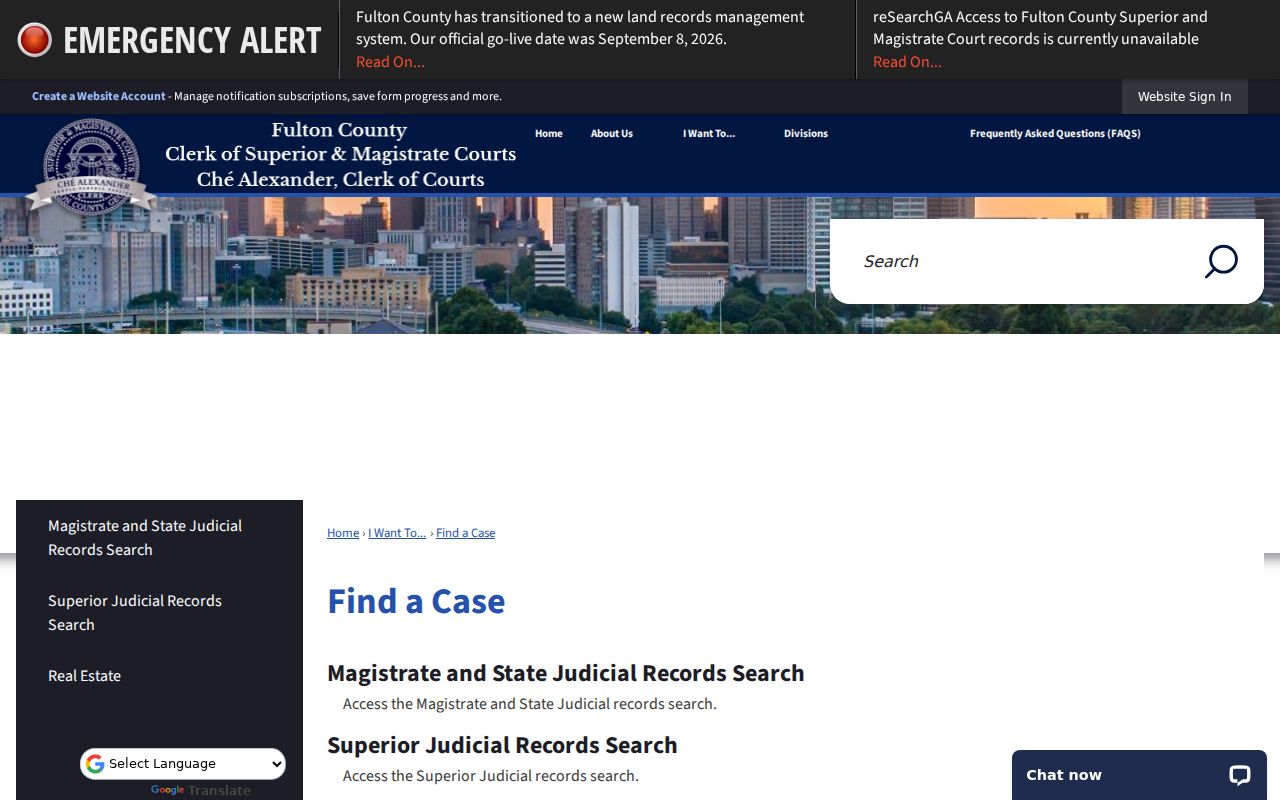
That example shows why court type matters in a case lookup. An older Georgia file may sit on paper, microfilm, or at an offsite storage site, so ask the holding clerk before deciding a docket result means unavailable. Remember that PACER is federal. It will not search a Georgia county or state-court docket.
Georgia Docket vs Court File
Think of a Georgia docket as the index and timeline. It may list filings, hearings, orders, and judgments. The case file behind it can hold pleadings, exhibits, notices, and transcripts. A portal sometimes shows only part of the record. It may charge for an image. Or it may leave out a document you must request straight from the clerk.
Federal cases live in a separate system. Georgia federal district cases run through national PACER. Georgia county and state courts use their own provider paths. The official PACER access and registration page explains the federal search route.
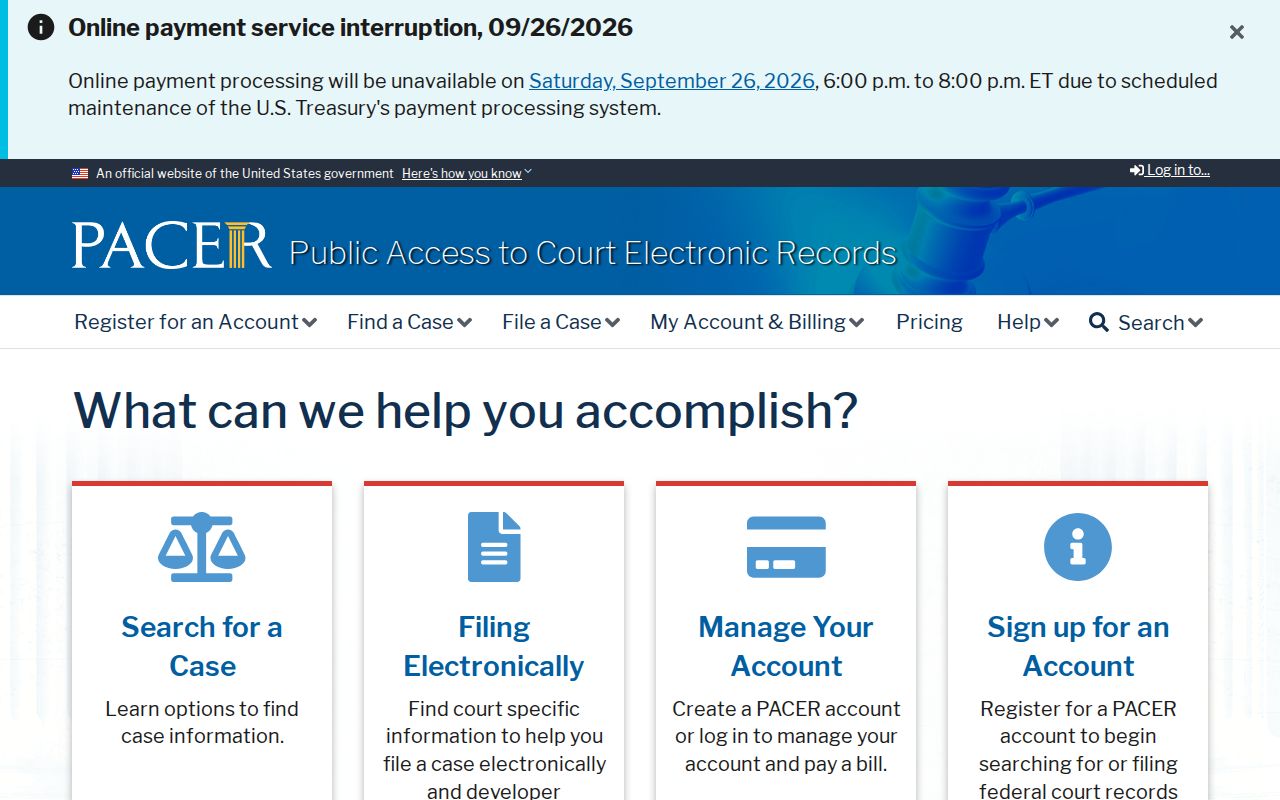
PACER never searches Georgia state-court files. A federal result also will not replace the official copy. Check the docket and the issuing clerk for the record type and authentication required.
Types of Georgia Court Records
A Georgia court record might be a case register, a filed paper, a signed decision, or the full set assembled for appeal. Superior, State, Probate, Magistrate, Juvenile, and Municipal Courts each keep records for their own work. Local offices sometimes share staff or a portal. Even so, each file stays with the court that has jurisdiction. Appellate courts open a separate Georgia docket when they take a case on review.
Free archives hold some Georgia federal filings, but coverage is incomplete. The public CourtListener and RECAP search gathers docket material contributed from PACER use. It may miss newer or uncollected documents, and it is not the official court file.
For a state-court case, go back to the county and court provider. Ask that clerk if the search stalls. For a federal case, use PACER and verify the document with the federal court that keeps it.
Georgia Court Copy Fee Snapshot
No single amount prices every Georgia court record. State law sets base charges for Superior Court copies and certification. Viewing, card processing, filing, delivery, and reporter work can all add cost. Probate and lower-court fee schedules differ. The Superior Court rate does not govern every Georgia case.
Quick answer: A Georgia Superior Court plain copy costs $0.50 per page without clerk assistance and $1.00 per page when assistance is required. Certification and electronic copies use separate statutory rates. Ask the clerk for the total.
The schedule separates a Georgia clerk's copy fee from portal charges.
Inside a Georgia Court Record
Georgia publishes no public sample docket proving one statewide field layout. A header typically names the Georgia court and the case number. An event list tracks activity by date. When an entry title alone does not explain the result, read the signed order. Read the judgment itself too.
| Georgia case number and court | Identify the file and the court or county that holds it; use the full number shown locally. |
|---|---|
| Georgia case style and type | Give a short caption and local class, though terms and public detail can vary. |
| Georgia filing and event dates | Show when a filing or court event was recorded; a filing date is not the hearing date. |
| Georgia pleadings and motions | Record requests and responses. A motion entry is not itself a ruling. |
| Georgia orders and judgments | Carry the court's signed direction or result. Later orders may change an earlier entry. |
| Georgia transcript or exhibit | May be held or produced separately; an online tab does not assure audio or a certified transcript. |
A Georgia public docket can show an event while holding back an attachment. Ask whether the document is restricted, unscanned, behind login, or held by another Georgia court. Portal labels vary by county, and no public sample establishes one statewide record layout.
Georgia eCertification and Court Copies
Electronic certified-copy requests run through eCertification. The Georgia Superior Court Clerks' Cooperative Authority offers the service through participating county clerks. Check the participation list before counting on it. The public screen offers sign-in plus an authentication lookup by code. The request form and its fields sit behind the account process. Georgia eCertification sets no statewide price and no common turnaround. So ask whether the county participates. Ask whether the document can be certified online, and how payment and delivery work. If not, request the copy from the clerk that holds the record. The official Georgia eCertification entry page shows the sign-in and county-participation route.
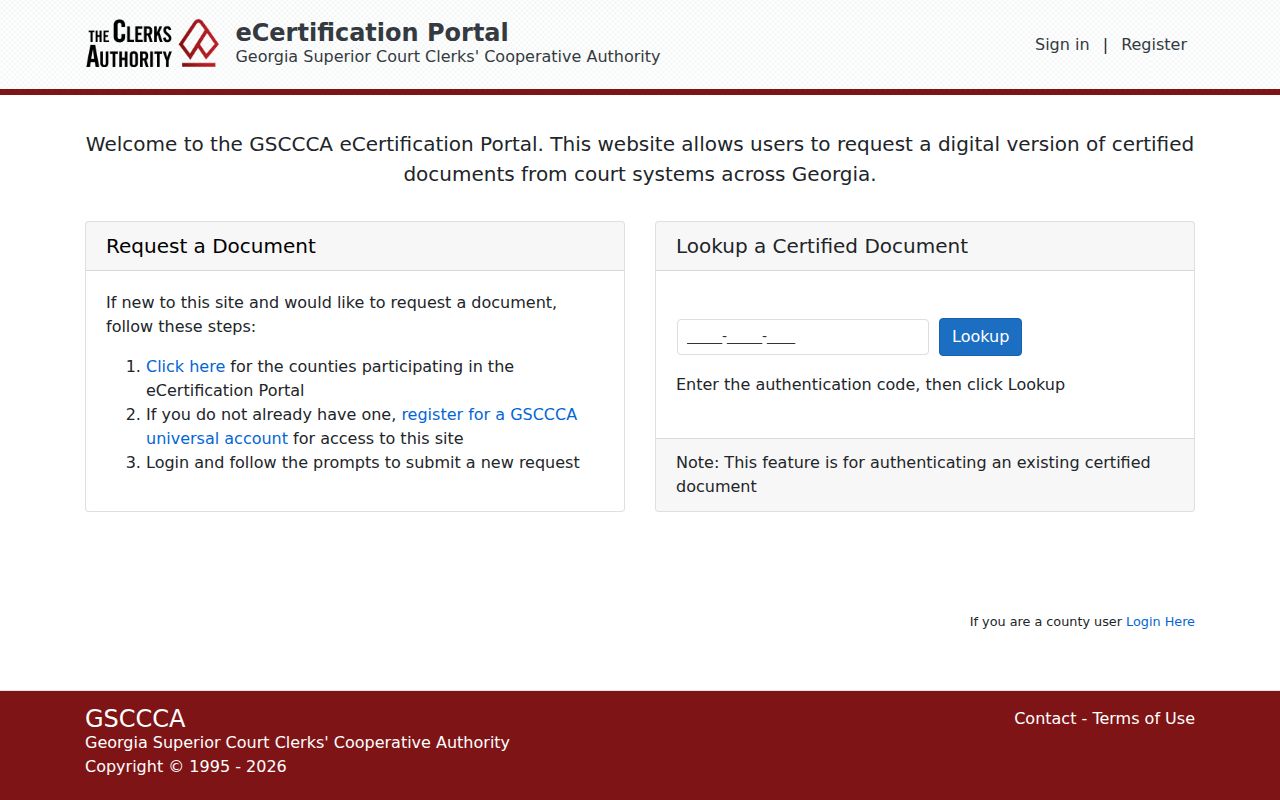
Digital certification in Georgia is still a clerk-issued record. A code lookup helps authenticate a certified document. It does not make every county file searchable in one database.
Georgia Certified Copies and Fees
Georgia law sets the baseline here. Under O.C.G.A. §15-6-77(g), Superior Court copy charges vary depending on clerk assistance, electronic transmission, and whether you need certification. Per-page terms are in the table. A portal or delivery charge may still be separate, so confirm the total with the Clerk of Superior Court; a county's published fee schedule lists local charges alongside the statutory amounts.
| Georgia Superior Court service | Georgia statutory base charge |
|---|---|
| Uncertified paper copy, no clerk assistance | $0.50 per page |
| Uncertified paper copy, clerk assistance required | $1.00 per page |
| Copy sent electronically or by telephone | $2.50 first page; $1.00 each later page |
| Certification or exemplification | $2.50 first page; $0.50 each additional page |
| Clerk's certificate or court seal | $1.00 for each listed item |
| Computer-generated printout | $2.50 per page or partial page |
A plain Georgia copy carries no clerk's attestation. Certification and a seal come with a certified copy. An exemplified copy adds another layer of authentication, which a receiving court may insist on. Ask that office which type it accepts before you order. Probate and lower-court fees differ, and no single statewide fee schedule covers every Georgia court. One more caution: ask about the quoted Georgia total. Confirm whether it includes a portal fee, delivery, or transcript production charges.
Georgia Court Records and Open Records
Georgia's Open Records Act, O.C.G.A. §§50-18-70 et seq., applies to public agencies. Courts sit outside it. The Georgia Attorney General states that Superior, State, Probate, and Magistrate Courts do not fall under the Act. The office does not mediate disputes over those files. So an Open Records Act request is the wrong tool. Send your copy request to the clerk instead. Follow the rules, statutes, and local process for that Georgia court.
Agency deadlines and copying rates do not bind a court clerk's schedule. If an image is missing, ask whether the portal requires an account. Ask whether the document is restricted, or whether the clerk must handle the request directly. Give the case number, the item, and the copy type you need.
Sealed Court Records in Georgia
Most ordinary Georgia court records are open. Still, no single switch seals a case across every court. A case can show in a public index while one document stays restricted, or the whole case may be absent from a public portal. Juvenile files carry their own statutory limits. A sealing order, a redaction rule, or a restricted case class can each narrow what the clerk may release.
Georgia's Uniform Superior Court Rule 21 presumes public inspection of Superior Court records unless law or a court order limits access. Rules 21.2 and 21.3 lay out the findings and temporary process for limits. Rule 21.6 covers redaction of specified personal identifiers. Redaction is not sealing. The entire file stays open even when a birthdate is masked. Juvenile Court files follow O.C.G.A. §§15-11-700 and 15-11-704, which generally require a court order for inspection subject to statutory exceptions.
Georgia access rules:
Georgia Open Records Act, O.C.G.A. §§50-18-70 et seq. covers public agencies; Attorney General guidance says named trial courts are not covered for their court files.
Uniform Superior Court Rule 21 governs public access limits in Superior Court records, including redactions under Rule 21.6.
Georgia Attorney General court-record FAQ explains that its Open Records Act process does not decide access disputes over those court files.
Juvenile Code, O.C.G.A. §§15-11-700 and 15-11-704 limits public access to juvenile hearings and files, subject to the statute's exceptions.
A missing Georgia result is not always a sealed case. Ask whether the portal excludes that court or case type, whether an account or fee is required, whether scanning is still pending, or whether a law or order restricts access. Use the court's own process to inspect restricted material. An Open Records Act complaint is no substitute.
Georgia Appeal Records and Transcripts
A Georgia appeal creates a second docket. The trial file may show the notice of appeal and the record transmission. Meanwhile the appellate clerk opens a new case number. That clerk tracks briefs, orders, hearings, opinions, and reconsideration. Check both records, not just one. The Supreme Court of Georgia public docket search offers a case-number field. Published material describes a five-year online range; older matters may require a clerk request. The Court of Appeals of Georgia links public case information and opinions. Certain eFAST functions serve counsel.
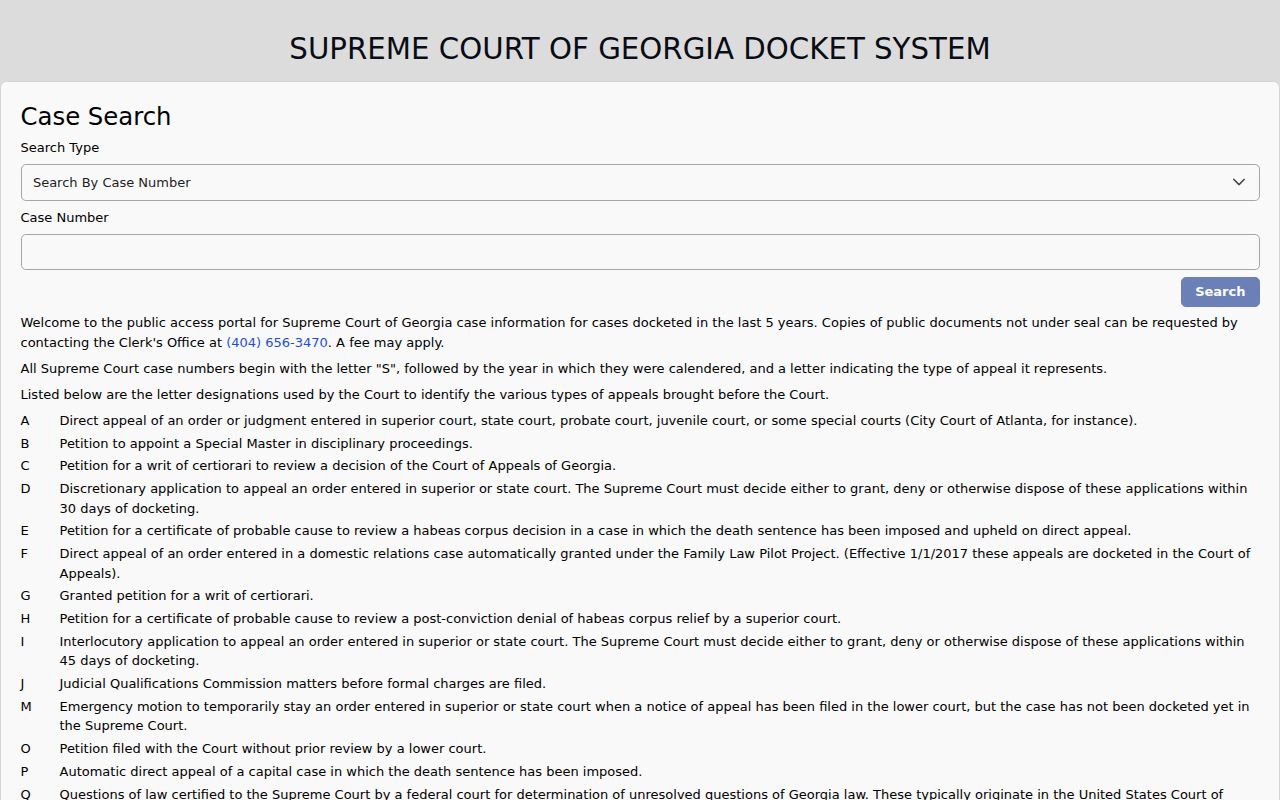
An opinion is not the whole appellate docket. The appellate clerk manages that court's filings and record copies. The trial clerk keeps the originating file. Before contacting either office, know the docket number and the exact document you need.
A Georgia hearing transcript is not a docket printout. Effective February 26, 2026, Uniform Superior Court Rule 36.19 governs authorized digital recordings in Superior Court. The court keeps its recording. A person who wants a transcript asks the court for help. The court then sends the recording to an authorized certified court reporter. If a transcript is already on file, request a copy from the clerk. Reporter rates and timing sit apart from ordinary copy charges. Keep in mind that Georgia trial and appellate records stay separate. They have separate clerks, case numbers, and copy request processes.